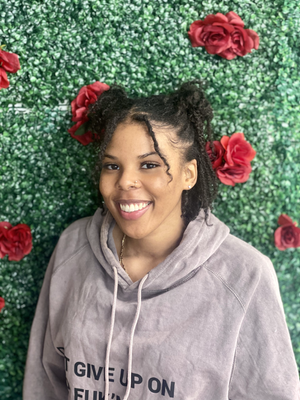
Maternal mortality doesn’t end in the delivery room.
What most don’t know about maternal mortality is that it doesn’t begin and end in the delivery room. It doesn’t just live in the moment of birth. It lives in the days after. The weeks after. The unanswered questions. The silence that follows when there should be explanation, accountability, and care.
It looks like a 28-year-old Black woman who gave birth—and never made it home. And somehow, the only explanation left behind is vague, clinical, detached. A system that moves on as if a life was not just lost.
It looks like a child growing up without her mother. Trying to make sense of something that was never fully explained. Learning early that grief doesn’t always come with closure.
That child was me.
I found my mother’s death certificate when I was 13. Not because anyone sat me down and told me what happened—but because I went looking for answers no one could give me. I remember opening my great-grandmother’s dresser drawer, moving things around quietly, carefully— like I already knew I was stepping into something heavy. Because in my family, the truth lived in silence. Tongues were too tied. The hurt was too deep to say out loud. But I needed to know.
And there it was. On paper. Clear as day in a way no one had ever been with me. Amniotic embolism. Words that felt clinical. Distant. But final.
I didn’t fully understand it then—but I understood enough to know that this was the reason my mother wasn’t here. That this was what took her from me. What I thought would bring clarity only brought more questions. More grief. More confusion than a 13-year-old should have to carry. Because what does that actually mean?
What happened in her body? What did it feel like? Was she scared? Did she know she wasn’t going to make it? Did she think about me?
And maybe the question that sat the heaviest— why are there no pictures of us together? No proof that we existed in the same space at the same time. No memory I could reach for that wasn’t built from imagination. Just a document. A cause of death. And a lifetime of trying to piece together a story from fragments.
And still—this is what people don’t understand about maternal mortality. It is not just about dying during childbirth. It is about what happens when a mother says something is wrong and no one listens. It is about what happens when care ends too soon. It is about what happens in the hours, days, and weeks after—when systems fail quietly. And for Black women, those failures are not rare. They are patterned. They are predictable. They are preventable.
I am a doula not solely because of what happened to my mother— but because I understand, in a way that cannot be taught, that Black mothers and babies deserve to live. Fully. Safely. Whole.
They deserve to be seen, heard, believed, and protected—before, during, and long after birth. They deserve care that does not disappear once the baby arrives.
Living without my mom has been its own kind of education. Not one I asked for—but one that shaped everything. It taught me how to survive. How to move through the world without expecting anything from it.
When I was eight years old, my father told me that no one owed me anything in this life. And I carried that with me. Deeply. So deeply that I learned how to do everything on my own. How to not need. How to not ask. How to not expect softness from the world. And for a long time, that worked. Until it didn’t. Because your heart will catch up with you. No matter how far you try to outrun it. No matter how much you convince yourself you don’t need anyone. One day, it meets you where you are. And it asks you to choose. To choose whether you will stay guarded or become open. To choose whether you will let your pain harden you—or allow it to deepen your capacity to feel, to love, to connect. And that choice is not easy. Especially when your story has taught you that loss can come without warning, and care is not always guaranteed.
But my encouragement is this:
Do not let it change you in a way that closes you. Do not let your heart become cold. Do not let survival be the only way you know how to exist. Because this work—this fight for Black maternal health—is not rooted in coldness. It is rooted in love. In care. In the belief that our lives are worthy of protection and dignity.
Black Maternal Health Week is more than participating in week-long events. It is more than panels and programming. It is about telling the truth. It is about naming what has been ignored for far too long. It is about honoring the mothers who should still be here—and supporting the ones who are here now. It is about living in your truth, even when that truth is heavy. It is about being—fully, unapologetically—despite what you have lost.
For me, it is about making meaning out of something that never should have happened. It is about standing in the gap between what was and what should be. It is about making sure that when Black women give birth, they are not entering into a system that treats their survival as optional. It is about making sure that care does not end at the hospital door—but continues into the homes, into the communities, into the full continuum of life after birth. It is about making sure that what happened to my mother is not the story someone else has to carry. Because this is not just my story.
It is ours.
And it deserves to be told.
Maternal mortality doesn’t end in the delivery room. For many families, it’s where the silence begins.